Children's Health · Nutritional Health · Parenting

Ultra-Processed “Food” and Kids

Today’s kids eat far too many ultra-processed foods or real-food-alternatives. Most people know this.

Besides the health problems (cardiovascular disease, high blood pressure, type 2 diabetes, obesity, depression, and some types of cancer) associated with a high ultra-processed diet… is the far more alarming false distinction that exists between ultra-processed food and junk food.

It’s Confusing… especially for children

For example: Soda and potato chips compared to fruit juice and most granola bars…one sounds like ‘junk food’ and the other sounds ‘healthy’.

The reality however is far different. Chips and most granola bars, soda and fruit juice… ultra-processed.

Sadly, not all parents are aware, or they don’t take this problem seriously. Maybe, they themselves are addicted to an ultra-processed diet, and the cycle continues.

The scary facts: By some estimates (depending on what article you’ve read) a staggering 73% of food products in our grocery stores are ultra-processed.

The Results for Our Children

  • A 2022 study by the American Society for Nutrition found that kids who consumed more ultra-processed foods had lower levels of physical fitness.
  • Researchers from England’s Imperial College London stated that high consumption of ultra-processed foods increased risk of childhood obesity. They discovered that one in five kids obtained 78% of their calories from ultra-processed foods.
  • The CDC reported a high obesity rate among children and teens…a staggering 14.4 million.
  • First Steps Nutrition Trust (UK) found nearly one third of baby/toddler foods are ultra-processed.
  • Studies also showed lower cardiovascular fitness in 12-15 year-old kids who consumed ultra-processed foods.

What does this mean for concerned parents?

Our children are consuming things today, that were not available to them, say, one hundred years ago…give or take a decade or two.

Added sugar, seed oils, chemicals, preservatives, emulsifiers, and so on literally plague our modern foods and they are slowly, but steadily…killing us.

The trajectory our children are currently on… those who eat more ultra-processed foods… is an unhealthy life as adults…

  • A recent study published in Cell Metabolism found that an ultra-processed diet led to an increase in liver fat, body weight, fat mass, and insulin resistance.
  • Another study found that these adults were more likely to develop type 2 diabetes, cardiovascular disease, obesity, and other metabolic diseases.

Ultra-processed foods include: prepared foods like hotdogs, hamburgers, pizza, chicken wings and nuggets, as well as breakfast cereals, candies, packaged snacks, sweetened yogurts and juices, and canned soups.

It’s an epidemic that does not get the attention it deserves. Therefore, we continue down a path of poor health and the evidence is mounting.

Childhood Obesity, and Childhood Type 2 Diabetes were basically unheard of a few decades ago, but have now become a serious concern.

Grocery stores (places we trust) are stuffed with products that pass as food. These foods, (those with lengthy labels attached), are well-known to be ultra-processed. Consider that for every real food there is an ultra-processed alternative.

What’s a concerned parent to do?

Of those utlra-processed foods, a staggering number of cereal boxes alone, target children, both from the visible packaging to heavily commercialized ads. These cereal boxes, and ads, are enticements that present an overwhelming pressure; let’s not even think about snacks, beverages, frozen pizza, cookies, and on and on.

The above speaks to the numerous challenges concerned parents face on a daily basis. And what many of us have come to realize…nagging kids to choose foods without added sugar, seed oils, and etc. is not the best approach.

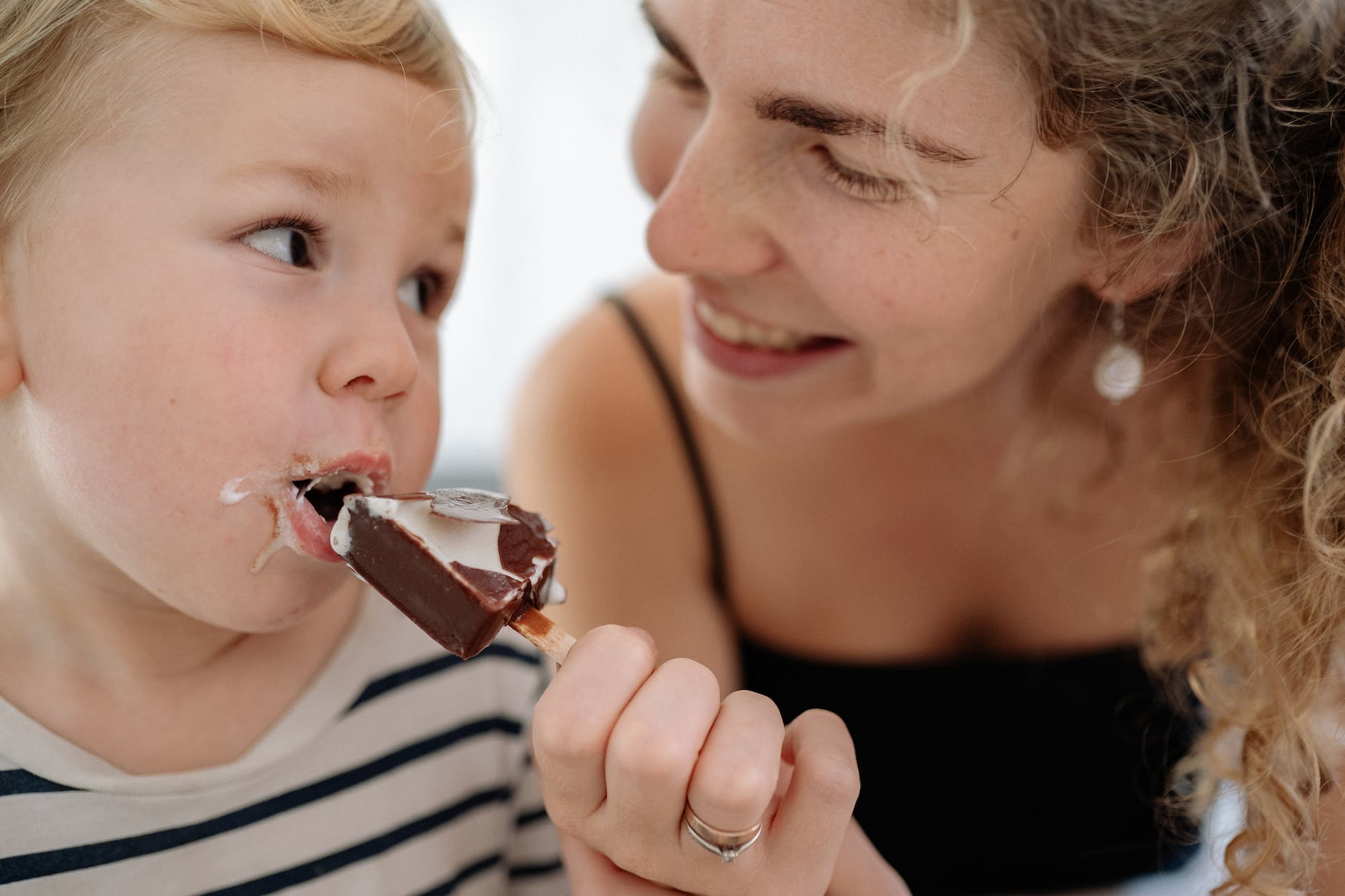
Deceptively Cute, Loving Picture – Not Helpful to Concerned Parents

So…given the almost insurmountable problems associated with kid targetted ads, pressure from peers, and of course…their own so called ‘sweet tooth’…what’s a concerned parent to do?

How do they reduce their child’s intake of sugar and ultra-processed food substitutes?

How to Get Kids Off Ultra-processed food

  1. Remember you are the parent…which means you are in charge. It might sound overly simple but the reality is…you don’t have to purchase the junk that your kids want. Putting your ‘proverbial’ foot down is not as hard as you might think. No one forces you to buy that horrible processed cereal (you don’t have to give in to the whining and nagging). Furthermore, with a little planning… breakfast can be nutritious and enjoyable. Examples include: plain yogurt with fruit, nuts, and seeds, scrambled eggs, whole wheat toast (especially if it’s homemade), hot cereal such as oatmeal or cream of wheat.
  2. Set the example…which means you have to stay away from the junk food…first! Kids don’t fall for their parent’s “do as I say, not as I do” speeches. This approach rarely works no matter how convincing you try to voice your concerns.
  3. Get educated…which means you have to understand the very real dangers of ultra-processed, sugar laden ‘foods’ to our metabolic health. With ample information, readily available online…there really is no excuse. Even a basic foundation on benefits to health and wellness, to a more indepth study at the cellular level…everyone can arm themselves with the facts. Knowledge is far more powerful than most people realize.
  4. Choose the right tools…which means investing your time and energy for the best items to spark the entire family into making better choices. This might be as simple as a jump rope to a more extravagant club membership. Whatever you decide, know that your efforts are worth every ounce of planning and penny spent (lol on that penny part…even though cost is not a laughing matter these days).

Choose Minimally Processed Foods for Your Children

  • Fresh vegetables and fruits (with more emphasis on vegetables, stay away from candies, carbonated soft drinks, “fruit” drinks and energy drinks)
  • Fresh meat and fish (avoid processed meats like hot dogs, sausages, luncheon meats, poultry and fish “nuggets” and “sticks”)
  • Dried legumes (avoid plant based meat substitutes)
  • Whole grains such as quinoa, brown rice, and whole wheat bread (restrict packaged breads, pastries, cakes, cookies, cake mixes)
  • Dairy products (organically raised and fed if possible; do not include flavored yogurts or processed cheese slices)

Read Labels… The longer the label the higher the ‘ultra’ part in ultra-processed.

To consider … choose the right books to help your child acquire their own health-awareness education.

Granola Brea Books by Suzanne Rightley might be just what your health-conscious family needs. This series of books is a small investment with an educational punch for kids between the ages of 10-14.

“Arming this age group, with a few healthy facts…before they are flung into the teen world, is a positive step toward helping your kids strive for, and achieve, health and wellness. If you don’t believe me…ask Granola Brea.” Suzanne, 2023

“abetterchat” with Suzanne · Kids Books · Sports-themed books for boys · Teens · Work Ethics

Tee It Up

What are your favorite sports to watch and play?

Funny thing about me and sports… ah… I don’t do sports. Lol. It may be because I don’t have a competitive bone in my body or I’m naturally clutsy. In any case I don’t have a favourite sport to either watch or play..

My husband, on the other hand, played hockey, baseball, lacrosse, and who knows what else, growing up. I get exhausted just hearing about it. And… for a time pursued golf both as an amateur and as a professional.

I do exercise… a lot actually, because of the benefits of exercise combined with a healthy diet (no added sugar and harmful seed oils).

I do write children’s fiction and have a sports-themed series going called Tee It Up, mainly because I can take advantage of my husband’s vast knowledge of sports. 😉

“Eddie’s Story“ by Suzanne Rightley

Eddie has what it takes to be a hockey superstar but struggles with making the big career choice because of his love for golf. With the help of family, friends (old and new), Eddie discovers a lot about himself during his summer job. Good book choice for boys 12-15.

Learn more about Suzanne Rightley’s Tee It Up Series. Visit her author page to discover more children’s fiction stories available as ebooks or paperback.

Money Management · Parenting · Responsible Parents

Budgeting: A Parent’s Opportunity to Shine

Write about your approach to budgeting.

My approach is simple. If there’s something you want and if you have the money and if it’s something necessary then…yes, go ahead and fit it into the budget. Otherwise…

“The best and surest way to save money is… Don’t Spend!”

A tried and proven method…LOL

Back on topic: Why is this a parenting moment?

Helping children develop vital life skills is an important aspect of parenting. No argument. Money management should be included on a parent’s To Do List.

Why? Answer: Kids will benefit, throughout the course of their lives, if they grasp the basic concepts of budgeting early in life.

The discussion…

The finer points of budgeting by example: Obviously food is kind of necessary so it needs a consistent, fixed spot on The Budget. However, even “food” is too broad a term when it comes to budgeting.

Things to consider…

  • Nutrition and real food
  • Pantry staples necessary for home cooked meals
  • Junk food (ah, not on my list but for some it’s a necessity, go figure)
  • Special occasions

If a necessity such as food must be evaluated…then think about how crucial it is to prioritize everything else.

Consider that many things can’t be eliminated, adjusted, or even tweaked from the budget.

  • Such expenses could be your rent/mortgage, car payments, heating, and etc.
  • These costs must have a fixed place

Then there’s the dreaded credit cards and credit card debt. Ugh!

Simply don’t go there, unless it’s an emergency. “To save and/or to stick to The Budget = No unnecessary spending on credit!”

  • By design, borrowing, via credit, is for emergencies but somehow we’ve taken it to the point of necessity… the “got to have it” mentality, which has nothing to do with emergencies.

The reality is a budget is just that “reality”!

Therefore, budgeting affords us the opportunity to live within our means.

This is a valuable life skill children should learn early in life. It is never too late to wean them off of the false notion that they should be entitled to “whatever they want” by their sheer existence alone.

Babies begin life believing everything belongs to them but it doesn’t take long, along their life’s journey, to realize that just isn’t so.

Confident in knowing they can control their spending habits!

Helping children adapt to that reality is something they can learn to appreciate if, we… parents, teachers, grandparents, and other significant adults, gift them with the knowledge of how to live within their means via the long-standing, proven methods of budgeting.

Suzanne Rightley is an author of children’s fiction. Health-awareness, Mystery, Detective, and Sports-themed Series are among her most popular books.

Visit her official website or author page to discover what the child/children, you know and love, can learn through the friendly, often humorous aspects of fiction.

Free Speech · Freedom of Expression · Opinions

Mis and Dis of Information

Accusations of ‘misinformation and disinformation’ have taken over ‘whenever and wherever’ opinions are bantered about. If it sounds silly… it’s because it is. However, ‘silly’ is too mild a word considering the devastating effects and impact these accusations produce.

Nonetheless, regardless of damaging outcomes, the mis and dis on the information spectrum has hit centre stage and… it affects all our lives, in place after place, throughout the world.

The finger pointing has become relentless.

Moreover, the spotlight seems firmly fixed under the broad topic of life choices. Somehow, some may say, miraculously, many of us have become overnight experts, often in the absence of proof. But, hey…

“Let’s not get confused by the facts. Please!”

And of course, as with any great stage performance, a bit of truth often merges with the fiction, in order to deliberately capture our attention, often prompting a ‘call to action’… literally or figuratively speaking.

As it turns out, mis and disinformation aren’t only playing themselves out before our very eyes, as the unsuspecting viewing audience to the theatrics, but we’ve become participants…members of the cast.

Pointing the finger at “the other side” of an argument has never been easier. (Think Twitter!) What is lacking is reasonable debate.

Accusations prevent actual information from coming to light.

The necessity to speak candidly and freely with one another has never been greater.

To Do…

  • Take the time to listen to someone else’s thoughts, opinions, ideas, facts, data, feelings, and etc.
  • We can, and do, learn from others.
  • Keep an open mind.
  • Hear all sides before making an informed decision.

Simply screaming ‘misinformation or disinformation’ is not doing anyone any justice. We owe it to ourselves, and our children, to gather actual information; there’s plenty that is readily available.

Taking someone else’s accusation of ‘mis and disinformation’ doesn’t cut it any more, if it ever did. Let’s endeavour to do our own homework and separate the accusations from the actual facts.

Future generations deserve honesty and integrity from us.

If healthy debate is required – let’s engage in that conversation!

Suzanne Rightley is an author of children’s fiction. Her books can be found listed on her author page or visit her website at suzannerightley.com