Character Development · Lifestyle Changes · Nutritional Health · Parenting · Parenting Tips

Nurturing Nutrition in Formative Years

It is generally understood that from conception to the first five to seven years of life (some argument here) a child’s brain is like a computer that readily accepts ‘downloads’ without any conscious effort on their part.

To understand the impact of the above statement, all a person needs to do is consider their own ‘default’ mechanisms. Example: under stressful situation what is his or her automatic reaction – run to the fridge, go full on silent treatment toward others, throw something, etc?

Parental Responsibility/Opportunity/Duty?

  1. Responsibilty – Parents want the best for their children. They want them to find their place in this world and to be content, happy, well-adjusted in life – in their careers, and personal relationships.
  2. Opportunity – Parents know the importance of the formative years. This is where a knowledgable parent takes advantage, and seizes the moment to build ‘character traits’ within the subconscious of their offspring, nurturing their individuality, personality, and intellect.
  3. Duty – Parents are expected to ‘rear’ their children into productive members of society. Is there a nation on earth that welcomes deviant behaviour in its citizens? Obviously not. To the contrary, a country can only benefit from a responsible, law-abiding population.

Photo by Pixabay on Pexels.com

Nutrition and Making Healthy Choices

Parents are in a unique place…

  • They can educate their children on merits of nutrition
  • They can provide them with nutritious meals, controlled snacks, necessary intermittent fasting intervals (refering to time needed between meals for metabolic health reasons)
  • Establish patterns of activity, exercise, sports, and so forth as a way of life; sitting around in front of TV screen/computer/mobile devices is not the best way to ‘pass time’ away

Ultimately… parents are the primary programmers of their child’s developing brain. The old adage of ‘do as I say, not as I do’ should give every parent of moment of reflection. Children are far more likely to ‘download’ your responses, your means of dealing with pressure, your choices, and etc. by what they witness you doing.

So, when it comes to making healthy food choices, help your growing child establish healthy patterns by first establishing your own. You might be able to give an impressive lecture on nutrition and the dangers of ‘added sugar’, but if your go-to response in times of stress is a bag of Oreos or a pint of Haagen-Dazs…
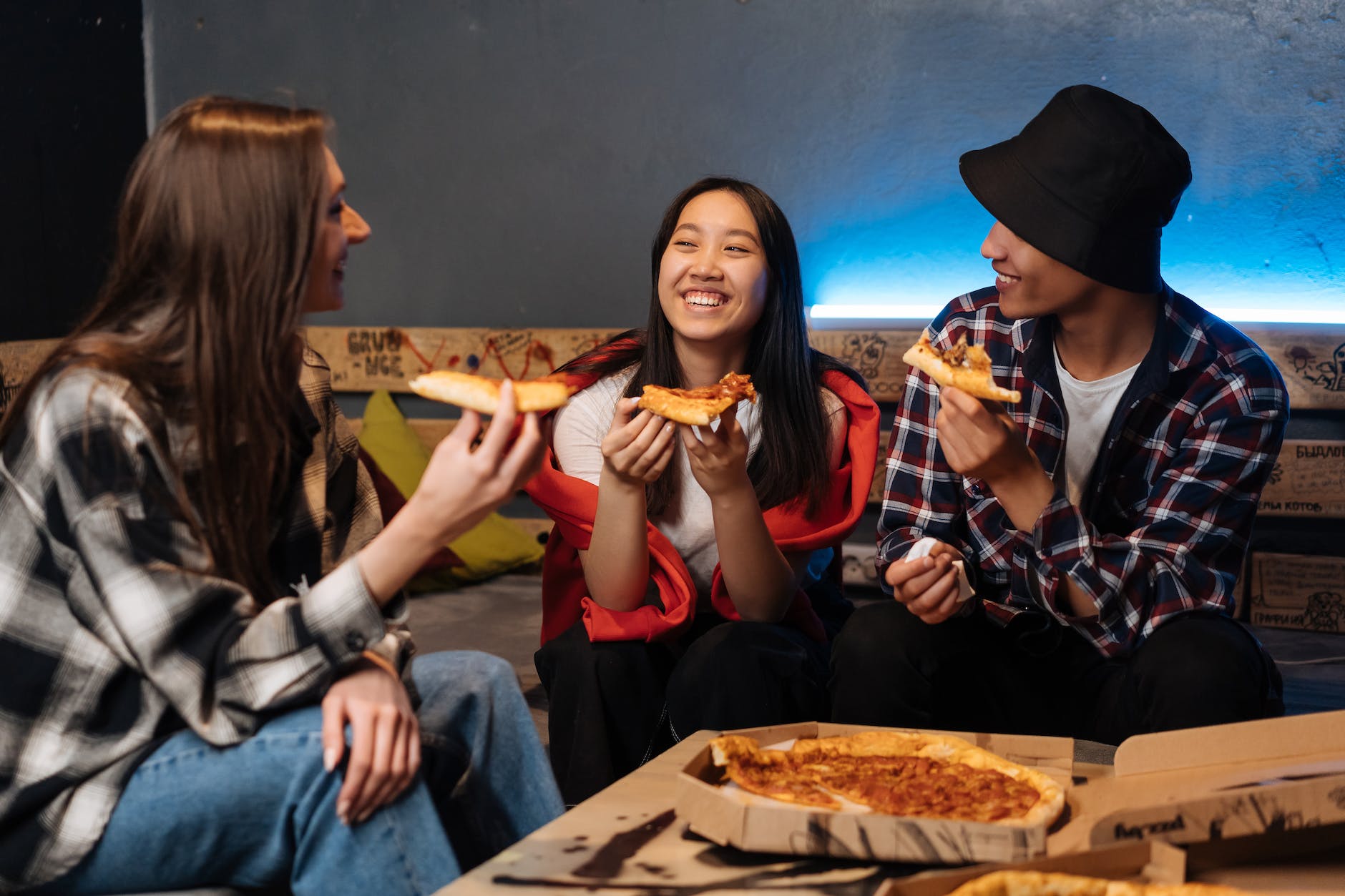
Then don’t be surprised if your child doesn’t make healthy food choices when hanging out with his or her friends.

Thanks for the visit.

Suzanne Rightley is a children’s author. She writes for independent readers between the ages of 7-15. Her genres include: mystery (7-9) detective (12+) sports-themed (12+) and health awareness (10-14).

For parents and teachers who look to educate kids in matters of health – Suzanne’s Granola Brea Series addresses issues of obesity, diabetes, dementia, and other metabolic diseases associated with poor lifestyles, including nutrition. Children learn about importance of making healthy choices as they laugh along with a 12-year-old health-nut… one hilarious incident after another.

After all… eating healthy isn’t always an easy thing to do… in our junk-food, overly processed world!

Visit Granola Brea’s Page on Suzanne Rightley‘s official website: Granola Brea Health-Nut

Avoid Processed Food · Kids Books · Nutritional Health · Parenting · Taking Care of Ourselves

Children’s Fiction Book Looks to the Future

If we educate our children on merits of healthy food today, they will change nutritional expectations tomorrow.

Ask a 10-year-old who Ralph Nader is… and you’ll probably draw a blank stare. In fact, many thirty-somethings might not have a clue, unless they had studied his life’s efforts in school.

I recently heard an interview with Dr. Robert Lustig, who has, and continues to direct much of his energy toward changing the current perception of nutrition, and the root causes of many, if not most, metabolic diseases today.

In the interview… and I’m paraphrasing from memory, so that’s like two strikes against me…lol… 

Dr. Lustig pragmatically, and wisely, stated (and I must agree) that his efforts, and the efforts of others, who hold similiar beliefs (based on scientific fact, btw), may not be the ones to actually effect the change, that he himself… and by extenstion… me, and many others… may not achieve his/our goals, dreams, visions, etc. in his/our lifetimes. 

(Just being realistic, I suppose.)

So, on the one hand…, my realistic side, agrees. Some things may feel as difficult as ‘climbing Mt. Everest’, but we ought not allow the difficulties to hold us back. If it’s the right thing to do… then ‘go for it’. 

So thank you Dr. Lustig and everyone else! 

Thankfully, many people, down through the pages of history, have endeavored to do just that… go for it! And, future generations are thankful, whether they know it or not

On the other hand, my hopeful side and… I dare say…, the hopeful side of anyone who endeavors to make their lifes’ work to improve quality of life…, is to see, with our own eyes, those changes come to pass, within our lifetimes. 

If we, those of us who want nutritional lifestyle changes, didn’t hope… didn’t expect to see those changes to begin… “like, yesterday”, to coin a popular phrase… would we put in the effort today?

On that note, I submit the work of Ralph Nader. Mr. Nader saw the need to confront the huge automotive industry and demand that seatbelts be, not an option, but a necessary part of every vehicle manufactured — just as important as, let’s say, the engine. 

He wrote a book, he formed groups, becames a spokesman, etcetera, etcetera. 

And… guess what — no internet, cell phones, twitter — no, none of that. No violent protests. Just hard, dedicated work. Think Phil Donahue interviews here, as an example… lol.

My point here… is to say, that it is possible to begin the efforts of change, and see it to its fruition. Mr. Nader saw the fruits of his labor. He undoubtedly drove a car, right off the lot, fully equipped with safety-minded seat belts. 

To that end… I throw my efforts, into that huge visionary pot. 

  • The food guide is not accurate. 
  • Added sugar is killing us. 
  • Healthy-saturated fats, such as butter and beef tallow, are not the bad guys – heavily-refined seed oils, aka, vegetables oils are the real killers.

Much of what is sold in our supermarkets should be tossed in the trash.

Processed foods are potentially toxic and are the leading cause of many diseases, including Obesity, Type 2 Diabetes, Dementia, Insulin Resistance, several types of Cancer, and Cardiovascular Disease.

Children today, will be the adults of tomorrow.

We may begin the change now. We may hope to see those changes become reality tomorrow, but the truth of the matter is… that it does take time.

Hopefully… They will grow up and live within the framework of our vision for healthy-nutritional lifestyles.

Granola Brea, Health-nut Books, written by Suzanne Rightley, is part of an effort for change. Kids who read these books today, will grow up with the facts, they will question what it is they are eating, and begin making right choices, expecting nothing less for their health and their future health.

The Granola Brea Books, available now on Amazon

Book 1 Granola Brea Confessions of a Health-nut

Book 2 Granola Brea Spotlight on a Health-nut

Lifestyle Changes · Parenting · Workplace

‘Quiet Quitting’ a Parental Opportunity?

Quiet Quitting has garnered a lot of interest in the business world these days. It’s advantages and disadvantages are being debated and evaluated on several levels.

So… Can this growing trend assist parents?

As most parents know – parenting is a 24/7 job – no quiet quitting allowed for them.

While children are young, they are their parents’ #1 priority. As a parent, you know where your children are… at all times… and you strive to make sure they are safe while they enjoy the fullness of childhood.

Quiet Quitting, in the workplace, might work for parents in unseen ways…

Why not consider this a time to kind of free up some mental space in order to…

  1. Gain emotional skills – Less stress in the workplace might mean a more balanced response time to typical parental triggers. No flying off the handle when laundry ends up under the bed instead of in the hamper.
  2. Planning opportunities – On those coffee breaks, a relaxed employee might take a few minutes to update chore schedules or browse for craft-making ideas.
  3. Evaluate current listening skills – When a working parent isn’t obsessed with the next spreadsheet or how to score points at an upcoming meeting, he or she might be thinking about the last conversation they had with their teenager. Did he tell me he has a new set of friends last night over our spaghetti dinner or is he going to the game with the same kids I know?

Really… the list could go on and on. A less occupied employee might easily mean a more occupied parent. A parent’s job is no easy task but coming at it with a peaceful, calm attitude rather than a harried one, might mean relationship benefits with your kids.

Although… as a word of caution

‘Quiet Quitting’ might sound like the perfect answer for the workplace, but don’t overdue it… 

Photo by Andrea Piacquadio on Pexels.com

It would be a real bummer to Quiet Quit to the extent your boss Quietly Decides… 

“This dreamer has to go!”

thanks for the visit

Suzanne Rightley Books for children available on Amazon.

Character Development · Parenting · Parenting Tips · Society and Values

Why Teaching a Child to “Ask” is a Great Character Forming Skill

Parents, good parents, and even less than good parents, have several things in common.

It doesn’t matter where we live, north, south, east, or west, parents love their kids, and they want the best for them.

Obviously, the above statement simpliflies the hopes and dreams that parents have for their children… but, you get the idea. Parents want their kids to grow up, be good citizens, and ultimately they want them to be happy in life.

Why Teach Kids to “ASK”

Think about it…

If a person takes the time to ‘ask’ permission for… well, just about anything… that person understands and respects the ownership of someone else. “May I use your restroom?” “Can you give me a lift, after work?” “Is it okay to use your name as a reference?” and so on and so on.

No-brainer you say?

Not true. Someone (hint, hint… a parent, teacher, neighbour, etc.) somehow or someway taught you and I the importance of ‘asking’.

Now consider the thief, the fraudster, plagiarist, etcetera – ‘asking’ seldom makes it to top of their priority list.

No… teaching a child to ask may seem like a ‘no-brainer’ because we kind of do it — naturally, but for the purpose of this blog… let’s consider how much better a child’s life could be … if … he or she, were specifically taught to ask.

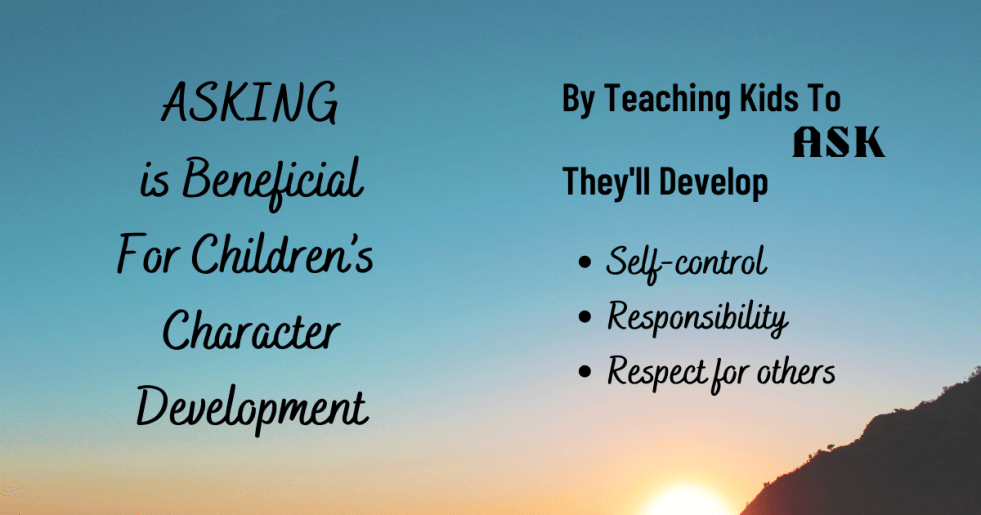
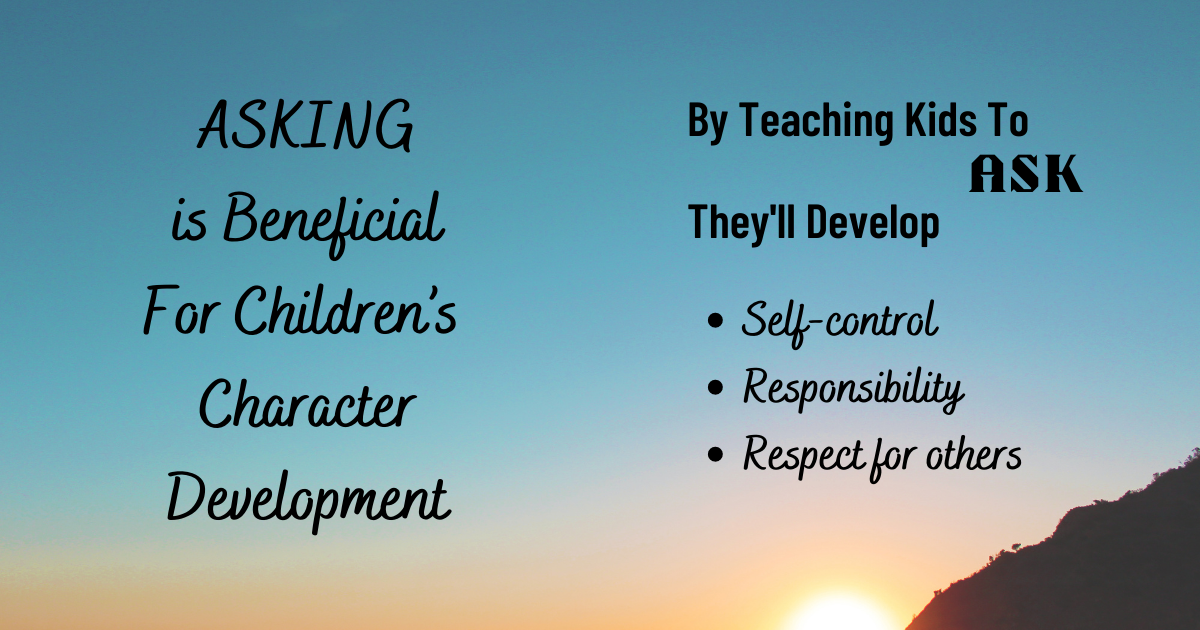
  1. Self-control – Teaching a child to ask is directly teaching them how to control themselves. Asking permission begins the process of setting limits. “Can I go out to play?” (Not now, you haven’t finished your homework.) “May I have another piece of cake?” (Too much added sugar isn’t healthy for you.)
  2. Responsibility – The underlying concept of ‘asking permission’ is the recognition of ownership. We ask others for the use of their things because we understand that those things belong to someone else. Furthermore, we have our own things that we are responsible for. Asking ultimately makes us responsible owners… We learn to ‘take care of our things’ once we are taught to appreciate our own possessions. “Can I play with your Legos?” (Okay, but don’t throw them all over my room.) This could be an example of two children who have been taught to recognize the value of ownership and the importance of asking permission.
  3. Respect for Others – Teaching children to ask is teaching children to be respectful for the rights of other people. At the end of the day… whether we agree or disagree with the actions of our friends, neighbours, etc… it becomes secondary to their rights of ownership (the items they own and the stipulations they place upon their belongings, or their thoughts, views, opinions, and beliefs). Being respectful is a valuable character trait that is undeniably appreciated the world over.

In summary

Teaching kids to ask is the responsibility of adults. It’s an easy concept to incorporate in daily life. “Did you ask me if it was okay to shove your dirty socks under the bed instead of the laundry hamper?” Add a lengthy speech about odors, bacteria, and the fact that sooner or later they’ll run out of clean socks… and you’ve taught a child that asking first may be the easiest, and less annoying way, to gravitate through life.

Thanks for your visit. Please check out Children’s Fiction Books written by Suzanne Rightley on her website: suzannerightley.com