Children's Health · Parenting · Responsible Parents

Listening to Kids: What They Say and Don’t Say

Hearing what kids say, and what they don’t say, is an important aspect of parenting.

What’s really going on?

When children first start speaking, parents are thrilled. They catch every new word (even when adoringly mispronounced) and they share their joy with … just about everyone they know and – considering TikTok, Instagram, Facebook, and etc., a whole lot of people they don’t know.

As time goes on, those wonderful first words turn into a lot of chatter, and chatter, and even more chatter.

Somewhere along the way, many parents sorta tune out some of the gibber-jabber. It’s not hard to understand why. A child’s repetitive chatter is well… repetitive.

But parents should not relax when it comes to listening to their children. As their child’s world broadens, so do the influences – both positive and negative.

From neighborhoods, to schools, after school activities and… of course, let’s not forget their friends… children face many situations.

So yes, parents cherish their baby’s first words. They’re extremely attentive. As they should be.

But, as time speedily moves on, parents need to be even more vigilant about their child’s expanding world.

The harmless chatter from toddlers and preschoolers can change suddenly. This can happen overnight, if parents do not keep their listening skills sharp.

As a responsible parent, you want to tune into the things your kids don’t (or maybe can’t) put into words. To do…

Sharpen Your Listening Skills

Catch What’s Missing
  • Sudden changes in your child’s interests/routines: If circumstances don’t seem to justify the reasons… then their wish to change a formerly cherished hobby may show something has become uncomfortable for them. Refusing to go to places they used to love may also signal discomfort. This discomfort might be causing anxiety.
  • When they avoid certain topics: Watch for kids who dodge questions about their friends, school, or even their feelings. This behavior may mean that something is amiss.
  • Becoming unusually quiet: Children tend to talk a lot about… everything. If that changes, and they become withdrawn, it may indicate they don’t know how to express their concerns.
Key body language cues to look out for
  • Facial expressions: If the expression on their faces doesn’t match their words, it can be a sign. They might not be truthful. A blank stare or a forced smile when they claim they are okay might indicate this.
  • Defensive posture: A child who fidgets, crosses their arms, or turns away from you may indicate they are withdrawing. This behavior may signal that something or someone is causing them discomfort or worry.
  • Attitude changes: emotional stress may be expressed as either sudden need for independence or excessive clinginess.
Listen to word choice & tone of voice
  • Vague: A child who says “I don’t care” or “whatever” might mean the exact opposite.
  • Too apologetic: Self-blame might mean a growing low self-esteem or they don’t want to disappoint you.
  • Joking about serious things: Humour can be a cover for insecurity.
What To Do Next…

As a concerned parent, you may have heard some of the following suggestions… “Validate your child’s feelings without telling them what to do.” (That makes sense.) “Ask open-ended questions to give your child the opportunity to fill in the blanks.” (Yeah, another good one.)

You could probably list several yourself.

But the big takeaway should be found within a parent’s attitude and commitment.

As children grow, they struggle to ‘fit in’ to their surrounding world. They might come across as being unreasonable or argumentative. They can also appear frustrated, etc. Parents often take the hit and trying to navigate through it, is similar to crossing a landmine.

The smart parent will understand and NOT take any outbursts as PERSONAL. They realize that all the ups and downs are part of that all important process we typically call… growing up.

In hindsight, those earlier toddler and preschool years were, not only wonderful, but much easier. However, remind yourself (repeatedly) that the ‘growing up’ years are also wonderful.

Strive to become a parent who understands. Allow your child the time they need to establish a firm footing in the world. You’re there to help when it’s necessary and … guess what … your child knows it.

Now… whether or not you should trust their friends, school, neighborhoods, etc… Not so much. Be vigilant and remember to listen to what your child is not saying. They may need you to step in with a few tips here and there along the way.

Suzanne writes fiction for kids 10-14. Her latest efforts target kids’ health and wellness. If you, or someone you know, are interested in lively health-focused narratives,for the children you care about, then visit her author page on Amazon.

Thanks for the visit.

Children's Health · Health and Wellness · Kids Books · Nutritional Health

Understanding Insulin: A Kid’s Guide by Nevin Smarts

“Ask a Nerd” (Nevin) Smarts Health Books, by Suzanne Rightley, inspire kids to make better choices. These books help kids make healthier decisions as they explore the topic of insulin. Targeted for ages 10-14, children seamlessly learn important facts about this crucial hormone.

Parents and teachers will appreciate the health-based content. Kids will enjoy the hero in the stories.

Nevin Smarts is a nerdy fifteen-year-old boy. He faces many challenges in promoting healthy choices.

About the Nevin SmartSeries

Nevin Smarts, aka, Nerdy Nev, is on a mission. His task? Motivate his friends, family, and beyond… to actively pursue their own health and wellness.

His motto? 

“Your health is your first job. Do it right, and you’ll never have to fire yourself.”

Get healthy! It’s on everyone’s mind, and Nevin Smarts is no exception. With an above average IQ, Nevin knows he can do his part to promote healthy living.

Insulin: Hero or Villain (Book 1, kids 10-14)

Cover sleeve – Book available on Amazon

Book 1 – Insulin: Hero or Villain

When it comes to insulin, Nevin cuts through the noise. He explains how insulin works. Yes…what you choose to eat and drink, does matter… a lot!

“Do you want insulin to be your friend or your enemy?”

Great Question! In this “Ask a Nerd” Smarts Book, Nevin shares what everyone should know about the amazing hormone, we call… insulin.

One day, Nevin is asked…”What’s up with insulin?”

Not the most brilliant question he’s ever heard, but regardless, Nevin is thrilled, and ready, to face the challenge.

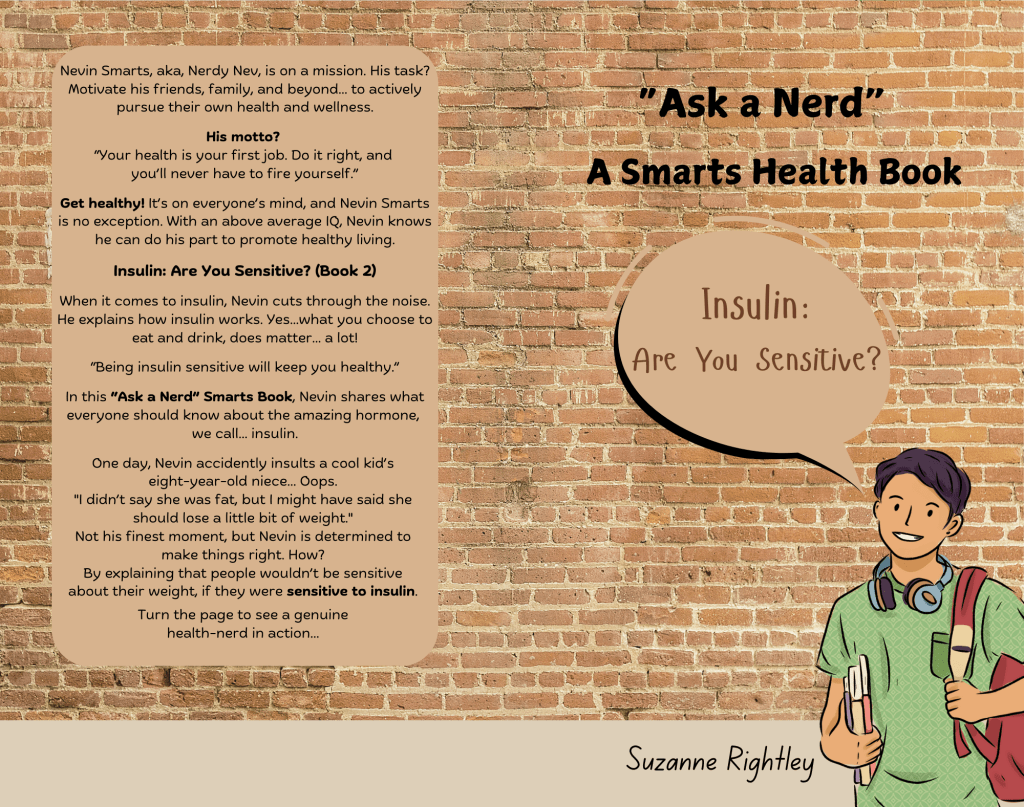
Insulin: Are You Sensitive? (Book 2, kids 10-14)

Cover sleeve – Book available on Amazon

Book 2 – Insulin: Are You Sensitive?

One day, Nevin accidentally insults a cool kid’s eight-year-old niece…Oops. “I didn’t say she was fat, but I might have said she should lose a little bit of weight.”

Not his finest moment, but Nevin is determined to make things right. How? By explaining that people wouldn’t be sensitive about their weight, if they were sensitive to insulin.

“Ask a Nerd” Smarts Health Books can be found on Amazon. For more books by Suzanne Rightley, including Granola Brea, Health-nut Series, visit her author page.

If you are worried about children’s health and want to take action, check out Suzanne Rightley’s health-based fiction books. These books offer friendly ways to share health information. Humour and lively narratives are an added bonus.

Health and Wellness · Lifestyle Changes

Why You Should Walk this Fall for Better Health

One of the best times of the year… Autumn!

Colourful leaves and distinctive Fall scents offer mood building moments along local walking paths. So, enjoy the crisp air during those brisk walks and take advantage for health’s sake!

The sounds, sights, and scents of Fall

Beyond the emotional well-being and brain health aspects, walking is further touted as one of the best forms of exercise.

The Many Benefits of Walking
  • Cardiovascular Health – reduces the risk of heart disease, high blood pressure, and stroke
  • Weight Management – burning calories means weight loss or maintaining a healthy body weight
  • Mental Health (main topic of this post) – improves sleep quality, reduces stress, and can boost your mood
  • Chronic Disease Prevention – helps prevent or manage conditions like type 2 diabetes, certain cancers, arthritis, to name but a few diseases linked with metabolic syndrome
  • Immune Function – regular walking enhances the immune system helping to stay healthier and recover faster from illnesses
  • Muscle and Bone Strength – reduces risk of osteoporosis and improves muscle endurance
Breathe and Enjoy
Walking has a Positive Impact on Mitochondrial Function
  • Regular walking promotes the production of new mitochondria in cells. Which for us means more energy.
  • Walking helps your mitochondria work efficiently by producing more ATP … that much needed energy.
  • Daily strolls can help slow down cellular aging.

All of the above is great! Sure! Nonetheless, healthy mitochondria should not be our focus when we lace up our walking shoes. Rather anticipate what a stroll can give us, like peace of mind, which improves overall mental health, in an otherwise stressful world (thinking politics but let’s not go there)…

Hence the reason for an enjoyable and peaceful walk!!

Take Advantage of All Things Autumn

So, get out there. Enjoy the season. Take a few pictures and share photos from your place in the world.

And remember to breathe deep, smile… and… brace yourself for the soon coming winter (which isn’t so bad – it’s all in the attitude).

Suzanne writes children’s fiction stories to bring a little humour and stress-free moments that children need as well.

Children's Health · Health and Wellness · Lifestyle Changes · Nutritional Health

The Rise of Health Awareness: Exposing Ultra-Processed Foods and Corporate Greed

Awareness of the harms of ultra-processed foods is growing! YAY! People are learning that these products are toxic to human health and the reason for most metabolic problems plaguing literally millions today.

People are getting it!

Thanks to Robert Kennedy Jr, that awareness… hit the Trump stage recently, and a bunch of us got a tremendous boost to our persistently hopeful outlook for the health of men, women, and children throughout the world.

This ultra-processed food nightmare is not a new topic for many of us… but it is an eye-opener for literally thousands worldwide. It is a story that must be told and, if Kennedy has any say… he’ll tell it. Corporate greed exposed.

Wait… There’s more…

Kennedy endorsed Calley and Casey Means and shortly thereafter, Megyn Kelly interviewed Casey on her show. Their primary topic was on… are you ready for this… seed oils.

Yes, they exposed the damage of consuming these horrible oils on Kelly’s platform… a platform that boasts over 2 million followers. (Insert an excited fist bump here!)

But let’s not forget the trailerblazers…

As the awareness grows… and make no mistake it is growing… we should take a moment to acknowledge the many dedicated doctors, scientists, advocates, and lay people from across the globe who worked tirelessly to bring us the facts.

Without their efforts, many of us would still be consuming this sludge. Because of the many books, published papers, podcasts, video clips, shorts, and etc… we have avoided literally dozens of so called ‘food’ aisles for years.

Let’s acknowledge a few modern day heroes…

We learned that saturated fat isn’t the ‘bad guy’ from pioneers like Nina Teicholz. Her 2014 book, The Big Fat Surprise, continues to educate and is considered to be a ‘reference’ source for many.

Dr. Chris Knobbe’s 2023 book, The Ancestral Diet Revolution is another excellent publication detailing… well… everything you need to know about how we got into this mess in the first place.

You can’t hide the truth forever…

“Nor does anyone light a lamp and put it under a basket, but on a lampstand, and it gives light to all who are in the house.”

Matthew 5:15 (AMP)

Note: The above biblical quote seems to be taken a little out of context, but if ‘light’ reflects ‘truth’… then the truth can’t be hidden for long. Eventually, it comes to light, and all who learn of this truth are given the opportunity to gain from it. (In this case… we gain better health!)

Back to our modern day heroes…

Books by Gary Taubes, Dr. Robert Lustig, Dr. Jason Fung, Dr. Ben Bikman are among the many who have exposed the effects of ‘added sugar’ upon metabolic health… specifically, insulin resistance.

They have helped us understand diabetes at the cellular level and we now recognize that the conventional ways of treating this pandemic have NOT been the most effective.

Diet, exercise, and intermittent fasting now play key roles in recovery and… most importantly… PREVENTION.

Then there are the podcasters… Dr. Mark Hyman, Mike Mutzel, Max Lugavere, Dhru Purohit, Dr. Peter Attia, Jesse Chappus, Dr. Suneel Dhand, and many, many others. Untold hours of discussion, explanations, data, signs and symptoms, and reasonable conversations have all contributed to the awakening the world is desperate for.

A special thanks to the aforementioned ‘pioneers’ for their years of dedicated service. Without their groundbreaking efforts, many of us would not find ourselves so incredibily hopeful for a major shift in health awareness with, whatever lies ahead, in the hands of Robert Kennedy Jr’s MAHA movement.

Here’s hoping our world’s population can also start their journey to health and wellness.

Whenever possible, please acknowledge the above amazing people by supporting their efforts through word of mouth to friends, family, and co-workers or online with positive comments, likes, and shares.

If you know other great trailblazers, on this quest for health and wellness, please drop a comment below to share their worthy contributions as well.

Suzanne Rightley is a children’s fiction author who presents a health minded hero in the persona of a dedicated 12 year-old girl.

Granola Brea plans on being a consumer advocate when she grows up… but she’s practicing what she preaches… now! No easy feat!

The Granola Brea Series is available on Amazon for parents and teachers who welcome a lively — often humorous — format to educate children and help today’s youth on their own health journeys.

thanks for the visit