Tag: Healthy Choices
Reviving Kids’ Love for Reading and Health
Only 1 in 3 kids, aged 8-18, say they enjoy reading in their free time. Reading — for enjoyment — is at its lowest point in 20 years. Interestingly, children’s overall health is also at it’s lowest point. (54% of US kids have at least one chronic disease)
This should come as a “canary in the coal mine” warning for parents, teachers and… children’s authors.
Furthermore… according to the National Literacy Trust… many children associate reading with endurance rather than enjoyment. Reading! A drudgery! How is that even possible?
Additionally, it’s not only about how often kids read. It’s more about a lack of motivation and emotional connection with books.
Again—as an early warning—kids losing their love for fiction indicates a larger, more serious problem. Could this issue parallel their general declining energy and health?
Question: Why is this growing lack of interest in reading, and declining health among today’s youth happening now?
Too Much Screen Time
- Digital influences are constant distractions for kids.
- Bite-size posts and videos provide instant gratification
- Reading – by comparison – seem tedious and less stimulating
- To Do: Provide structured environment. Set daily limits, establish screen-free zones (before bed, during meals, face-to-face conversation), physical screen-free-zones (kid’s bedroom), stop non-stop background TV. Encourage new habits. Promote hobbies, sports, encourage reading time. Plan family time, and get outdoors.
Too Hard to Connect With Literary Content
- Reading feels like schoolwork
- Books might not connect with their interests
- Books mean searching and searching takes time and effort
- To Do: Help kids find books on topics they like. Read aloud, even as they get older. Use, but limit time spent on audiobooks to build vocabulary.
Too Difficult/Too Frustrating
- Reading requires comprehension and can be embarrassing or frustrating for kids who do not reach their age levels
- Feeling overwhelmed if content is too complex for their reading abilities
- Feel defeated before they even start
- To Do: Let kids pick books they enjoy. Set up a quiet time to read with them. Do not criticize. Instead, celebrate achievements regardless how small. If possible create a comfortable reading space.
Too Busy
- Kids have schedules and extracurricular activities that compete with reading time
- Homework takes up valuable time away from reading for enjoyment
- To Do: Keep interesting books handy. Encourage some reading as part of the bedtime routine. Use car rides as an opportunity to read. Model reading as an enjoyable moment in an otherwise busy day.
Then Factor In The Need for Kids’ Health Awareness
If we want children to understand the chronic diseases that might affect them… Then guess what? Reading is involved. Yikes.
Parents, teachers, and children’s authors must-of necessity-become much more creative.
If regular fiction is BORING and a CHALLENGE to one third of today’s kids, then how can health-awareness fit in?
Additionally, where would fitness guidance, in book-form, fit in?
To Do: Support a Developing New Genre of Fiction for Kids: Health-focused Kid Heroes
Introducing Suzanne Rightley’s Kid Heroes…

Brea
Brea, aka Granola Brea, is a 12-year-old girl who is driven by health. She aspires to become a consumer advocate when she grows up. In the meantime – she keeps busy. She writes a monthly article for her local paper. Brea holds a summer job as a camp nutrition counselor for at-risk teens. She also hosts a kids health-based podcast.
Find Brea’s Books on Amazon: Granola Brea Health-nut Series; The Granola Experience
Nevin Smarts
Nevin, aka Nerdy Nev and/or Smartypants (not his preferred nickname for obvious reasons). Nev has a high IQ. He has several distinct goals, all of which sees him attending university for a few years. In the meantime, high school is providing practical experience in promoting health to his peers. Is it smooth-sailing? Ah… not so much, but nothing keeps this health-nerd down.
Learn more about Nevin on Amazon: “Ask a Nerd” Smarts Health; “Ask a Nerd” Smarts Health Habits
Maxine
Maxine, aka Maxie is dedicated to nutrition and fitness… and for good reason. She’s healthy now – thankfully, but that wasn’t always true. Her story is in developing stages as this blog is being written. Stay tuned for her first book in 2026.
Learn more about Suzanne’s books on her author page.
Understanding Insulin: A Kid’s Guide by Nevin Smarts
“Ask a Nerd” (Nevin) Smarts Health Books, by Suzanne Rightley, inspire kids to make better choices. These books help kids make healthier decisions as they explore the topic of insulin. Targeted for ages 10-14, children seamlessly learn important facts about this crucial hormone.
Parents and teachers will appreciate the health-based content. Kids will enjoy the hero in the stories.
Nevin Smarts is a nerdy fifteen-year-old boy. He faces many challenges in promoting healthy choices.
About the Nevin Smarts Series…
Nevin Smarts, aka, Nerdy Nev, is on a mission. His task? Motivate his friends, family, and beyond… to actively pursue their own health and wellness.
His motto?
“Your health is your first job. Do it right, and you’ll never have to fire yourself.”
Get healthy! It’s on everyone’s mind, and Nevin Smarts is no exception. With an above average IQ, Nevin knows he can do his part to promote healthy living.
Insulin: Hero or Villain (Book 1, kids 10-14)

Cover sleeve – Book available on Amazon
Book 1 – Insulin: Hero or Villain
When it comes to insulin, Nevin cuts through the noise. He explains how insulin works. Yes…what you choose to eat and drink, does matter… a lot!
“Do you want insulin to be your friend or your enemy?”
Great Question! In this “Ask a Nerd” Smarts Book, Nevin shares what everyone should know about the amazing hormone, we call… insulin.
One day, Nevin is asked…”What’s up with insulin?”
Not the most brilliant question he’s ever heard, but regardless, Nevin is thrilled, and ready, to face the challenge.
Insulin: Are You Sensitive? (Book 2, kids 10-14)
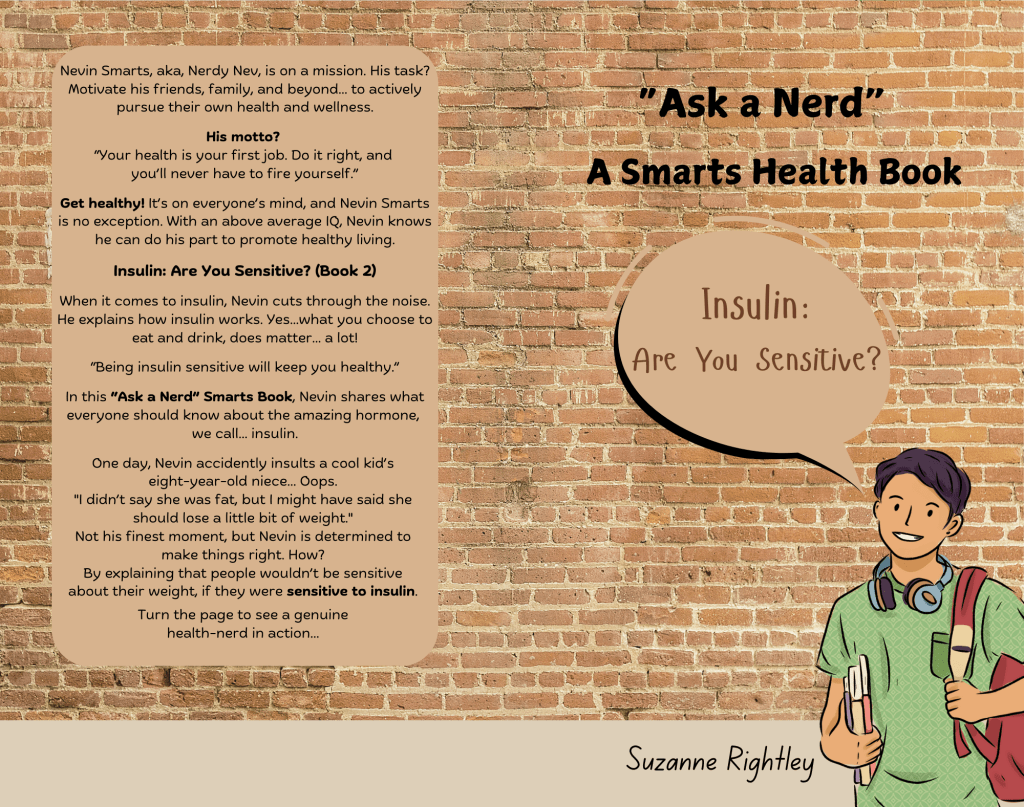
Book 2 – Insulin: Are You Sensitive?
One day, Nevin accidentally insults a cool kid’s eight-year-old niece…Oops. “I didn’t say she was fat, but I might have said she should lose a little bit of weight.”
Not his finest moment, but Nevin is determined to make things right. How? By explaining that people wouldn’t be sensitive about their weight, if they were sensitive to insulin.
“Ask a Nerd” Smarts Health Books can be found on Amazon. For more books by Suzanne Rightley, including Granola Brea, Health-nut Series, visit her author page.
If you are worried about children’s health and want to take action, check out Suzanne Rightley’s health-based fiction books. These books offer friendly ways to share health information. Humour and lively narratives are an added bonus.

Becoming Your Own Health Manager: A Guide to Taking Charge of Your Wellness
At what age should you seriously consider being the manager of your own health? Your twenties? Thirties? Forties? Your sixties?
The short answer… today. Today is the day you should firm up your commitment to becoming ‘in charge’ of your health and wellness. If you’re alive… as in breathing, regardless of your age… now is the optimum time to add Health Manager to your resume.
Think of your health as you would a job and begin to reap the benefits almost immediately. No kidding.
To Do…
Get Educated
As with any employment, being well educated means being better qualified. When it comes to your health…acquiring the best and most comprehensive education is vital to your overall performance. Thankfully, the resources are plentiful and easily accessible… think Internet. (YouTube videos are very informative)
Focus on the Key Components of Your Education
There are several ‘courses’ to choose from and the sky is the limit when it comes to acquiring an education in all things health. Consider the following key aspects…
A Healthy Diet
- The quick and lazy method would have you accepting the basic food guidelines provided by the so called ‘experts’.
- However, a more thorough search, which does require your time and enery, would expose the errors, misconceptions, and possibly the deceptiveness of these guidelines.
- Do your ‘due diligence’ here and you won’t regret it. Don’t allow the sheer number of diets and diet plans to overwhelm you. Choosing low carb, carnivore, keto, mediterranean, and so forth will come easier once you’ve taken the time to understand the basic food groups, which are: protein, carbohydrates, and fats.
- Get familiar with how these food groups help establish your health and wellbeing. Understand how they benefit the body and learn to prioritize according to your body’s basic needs. Hint: carbs shouldn’t dominate the day. So prepare yourself (give yourself a mental headshake)… cut the cookies, donuts, crackers, bagels, and other ‘fun’ stuff that you’ve come to rely upon during coffee breaks. It takes time, but well worth the effort.
- Quick tip: If what you want to eat comes wrapped with a lengthy label…odds are that this ‘food’ is not actually ‘food’ but an ultra-processed substitute. So… focus on real food and … wait for it … learn to cook ‘real food’ at home!
- Renowned functional medicine expert, Dr. Mark Hyman, has the following to say…
“It is food – we now know that food is information, not just calories, and that it can upgrade your biologic software. The majority of chronic disease is primarily a foodborne illness. We ate ourselves into this problem and we have to eat ourselves out of it.” Mark Hyman
Consistent Exercise and Movement
- Contrary to popular opinion, exercise does not need to be a drudgery or a painful process. Well…okay…there can be some pain (sore muscles) but not the torturous pain designed to kill you.
- The benefits of exercise are..well.. phenomenal. No joke! Many more doctors have come fully onboard and they’ll tell you that regular exercise is super important towards achieving health and wellness and a leading method to decrease all cause mortality (that word alone makes a person shiver).
- Exercise ranks higher than pharmaceuticals when dealing with depression and studies now show that regular activity helps cognitive improvements and greatly lessens the likelihood of developing various forms of dementia in later life.
- Prominent physician and longevity expert, Dr. Peter Attia says it well…
“Exercise is by far the most potent longevity ‘drug’. No other intervention does nearly as much to prolong our lifespan and preserve our cognitive function.” Peter Attia
Sleep and Relaxation (aka… meditation)
- Getting your Zzzzs can’t be overemphasized. Research has shown that many necessary bodily functions occur when we sleep, including a major cleaning… really! It’s like your brain is so busy during the day that, like a busy office, the garbage collects. During sleep hours, the cleanup crew get their shot at setting the place to rights before the next busy day begins.
- Quality sleep helps in many ways: corrects and stabilizes immune function, disease resistance and overall well-being, including mood.
- Mindful breathing calms the mind and body and may alleviate depression and anxiety by promoting relaxation and stress reduction.
- Deep breathing may enhance focus and cognitive performance; it may positively impact mood and happiness, and… mindful/deep breathing may lower blood pressure, improve overall cardiovascular, better lung function to oxygenate the body.
- Quotes from Matthew Walker’s book: “Why We Sleep: Unlocking the Power of Sleep and Dreams…
“Sleep is the single most effective thing we can do to reset our brain and body health each day.” Matthew Walker
In conclusion:
Metabolic related diseases, such as cardiovascular disease, type 2 diabetes, dementia, and obesity, to name a few, are steadily increasing. These types of problems are so widespread, we’ve almost come to the point of acceptance, as though it is inevitable to develop some sort of chronic disease.
But this need not be the case.
Those who choose to become managers of their own health – those who make their own fitness and wellness a lifelong job will undoubtedly reap benefits far beyond their expectations.
If you do not have ‘personal health manager’ on your life’s resume, the time couldn’t be better to begin the process of self-improvement.
You won’t regret it.
Suzanne Rightley is an author of childrens’ fiction. Her books are written for independent readers, ages 7-15 and can be found on Amazon. Her Granola Brea Series is an ongoing effort to enlighten today’s youth to make positive health and wellness choices for themselves.
Thanks for the visit.
 abetterchat